

Which Element Has 7 Neutrons
four.8: Isotopes - When the Number of Neutrons Varies
- Folio ID
- 47477
- Explain what isotopes are and how an isotope affects an element'due south diminutive mass.
- Determine the number of protons, electrons, and neutrons of an element with a given mass number.
All atoms of the same element have the same number of protons, but some may accept different numbers of neutrons. For example, all carbon atoms accept six protons, and most take six neutrons every bit well. But some carbon atoms have vii or eight neutrons instead of the usual vi. Atoms of the aforementioned element that differ in their numbers of neutrons are called isotopes. Many isotopes occur naturally. Commonly one or 2 isotopes of an element are the most stable and mutual. Different isotopes of an element generally take the same physical and chemical backdrop considering they accept the same numbers of protons and electrons.
An Instance: Hydrogen Isotopes
Hydrogen is an example of an element that has isotopes. Iii isotopes of hydrogen are modeled in Figure \(\PageIndex{1}\). Most hydrogen atoms take just one proton, one electron, and lack a neutron. These atoms are simply called hydrogen. Some hydrogen atoms have one neutron as well. These atoms are the isotope named deuterium. Other hydrogen atoms accept two neutrons. These atoms are the isotope named tritium.
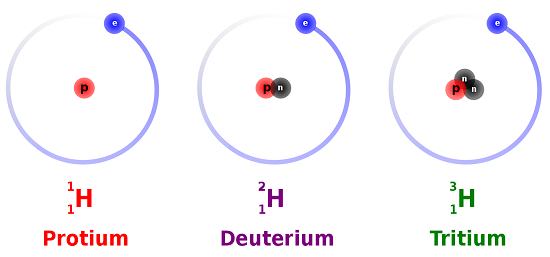
For well-nigh elements other than hydrogen, isotopes are named for their mass number. For case, carbon atoms with the usual 6 neutrons have a mass number of 12 (6 protons + 6 neutrons = 12), so they are chosen carbon-12. Carbon atoms with seven neutrons have an diminutive mass of 13 (half-dozen protons + 7 neutrons = thirteen). These atoms are the isotope chosen carbon-13.
- What is the atomic number and the mass number of an isotope of lithium containing 3 neutrons?
- What is the atomic number and the mass number of an isotope of lithium containing 4 neutrons?
Solution
A lithium cantlet contains 3 protons in its nucleus irrespective of the number of neutrons or electrons.
a.
\[ \begin{marshal}\text{diminutive number} = \left( \text{number of protons} \right) &= 3 \nonumber \\ \left( \text{number of neutrons} \right) &= three \nonumber\terminate{align} \nonumber \]
\[ \begin{align} \text{mass number} & = \left( \text{number of protons} \right) + \left( \text{number of neutrons} \right) \nonumber\\ \text{mass number} & = 3 + 3 \nonumber\\ &= half dozen \nonumber \end{marshal}\nonumber \]
b.
\[ \begin{align}\text{diminutive number} = \left( \text{number of protons} \correct) &= 3 \nonumber\\ \left( \text{number of neutrons} \correct) & = 4\nonumber\end{align}\nonumber \]
\[ \brainstorm{marshal}\text{mass number} & = \left( \text{number of protons} \correct) + \left( \text{number of neutrons} \right)\nonumber \\ \text{mass number} & = three + 4\nonumber \\ &= vii \nonumber \end{align}\nonumber \]
Detect that because the lithium cantlet always has 3 protons, the atomic number for lithium is always 3. The mass number, yet, is 6 in the isotope with iii neutrons, and 7 in the isotope with 4 neutrons. In nature, simply certain isotopes be. For instance, lithium exists as an isotope with iii neutrons, and equally an isotope with 4 neutrons, but it doesn't be as an isotope with 2 neutrons or as an isotope with v neutrons.
Stability of Isotopes
Atoms need a sure ratio of neutrons to protons to have a stable nucleus. Having too many or too few neutrons relative to protons results in an unstable, or radioactive, nucleus that will sooner or later break downward to a more stable form. This process is called radioactive decay. Many isotopes have radioactive nuclei, and these isotopes are referred to equally radioisotopes. When they disuse, they release particles that may be harmful. This is why radioactive isotopes are dangerous and why working with them requires special suits for protection. The isotope of carbon known as carbon-14 is an example of a radioisotope. In contrast, the carbon isotopes called carbon-12 and carbon-thirteen are stable.
This whole discussion of isotopes brings us dorsum to Dalton's Atomic Theory. According to Dalton, atoms of a given element are identical. Only if atoms of a given element tin can have different numbers of neutrons, so they can accept different masses likewise! How did Dalton miss this? It turns out that elements found in nature exist as constant uniform mixtures of their naturally occurring isotopes. In other words, a slice of lithium always contains both types of naturally occurring lithium (the type with 3 neutrons and the type with 4 neutrons). Moreover, it always contains the 2 in the same relative amounts (or "relative affluence"). In a clamper of lithium, \(93\%\) will always be lithium with 4 neutrons, while the remaining \(seven\%\) will always be lithium with 3 neutrons.
Dalton always experimented with large chunks of an chemical element—chunks that independent all of the naturally occurring isotopes of that element. As a result, when he performed his measurements, he was actually observing the averaged properties of all the different isotopes in the sample. For most of our purposes in chemistry, nosotros will do the same affair and deal with the average mass of the atoms. Luckily, aside from having different masses, about other backdrop of different isotopes are similar.
There are 2 main means in which scientists frequently evidence the mass number of an atom they are interested in. It is important to note that the mass number is not given on the periodic tabular array. These ii ways include writing a nuclear symbol or past giving the name of the element with the mass number written.
To write a nuclear symbol, the mass number is placed at the upper left (superscript) of the chemical symbol and the atomic number is placed at the lower left (subscript) of the symbol. The complete nuclear symbol for helium-4 is fatigued below:
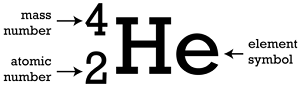
The following nuclear symbols are for a nickel nucleus with 31 neutrons and a uranium nucleus with 146 neutrons.
\[\ce{^{59}_{28}Ni} \nonumber \]
\[ \ce{ ^{238}_{92}U} \nonumber \]
In the nickel nucleus represented above, the atomic number 28 indicates that the nucleus contains 28 protons, and therefore, it must contain 31 neutrons in lodge to take a mass number of 59. The uranium nucleus has 92 protons, as all uranium nuclei practice; and this particular uranium nucleus has 146 neutrons.
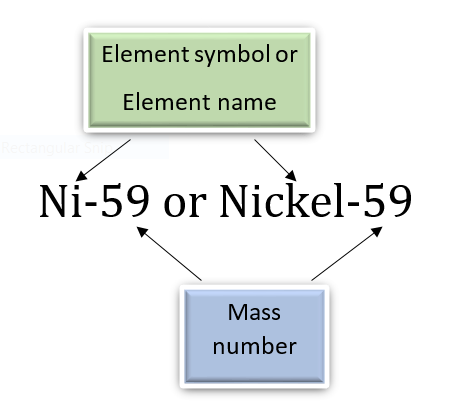
Another style of representing isotopes is by adding a hyphen and the mass number to the chemical proper noun or symbol. Thus the two nuclei would be Nickel-59 or Ni-59 and Uranium-238 or U-238, where 59 and 238 are the mass numbers of the two atoms, respectively. Note that the mass numbers (not the number of neutrons) are given to the side of the name.
How many protons, electrons, and neutrons are in an atom of \(^{40}_{xix}\ce{K}\)?
Solution
\[\text{atomic number} = \left( \text{number of protons} \correct) = 19 \nonumber \]
For all atoms with no accuse, the number of electrons is equal to the number of protons.
\[\text{number of electrons} = 19 \nonumber \]
The mass number, 40, is the sum of the protons and the neutrons.
To notice the number of neutrons, subtract the number of protons from the mass number.
\[\text{number of neutrons} = 40 - xix = 21. \nonumber \]
How many protons, electrons, and neutrons are in an atom of zinc-65?
Solution
\[\text{number of protons} = 30 \nonumber \]
For all atoms with no charge, the number of electrons is equal to the number of protons.
\[\text{number of electrons} = xxx \nonumber \]
The mass number, 65, is the sum of the protons and the neutrons.
To discover the number of neutrons, decrease the number of protons from the mass number.
\[\text{number of neutrons} = 65 - 30 = 35 \nonumber \]
How many protons, electrons, and neutrons are in each atom?
- \(^{60}_{27}\ce{Co}\)
- Na-24
- \(^{45}_{twenty}\ce{Ca}\)
- Sr-xc
- Answer a:
- 27 protons, 27 electrons, 33 neutrons
- Answer b:
- eleven protons, 11 electrons, 13 neutrons
- Respond c:
- 20 protons, twenty electrons, 25 neutrons
- Answer d:
- 38 protons, 38 electrons, 52 neutrons
Summary
- The number of protons is ever the same in atoms of the aforementioned element.
- The number of neutrons can be different, fifty-fifty in atoms of the same chemical element.
- Atoms of the aforementioned element that contain the same number of protons, merely dissimilar numbers of neutrons, are known equally isotopes.
- Isotopes of any given element all incorporate the same number of protons, so they have the same atomic number (for instance, the atomic number of helium is always 2).
- Isotopes of a given element contain different numbers of neutrons, therefore, unlike isotopes have different mass numbers.

Which Element Has 7 Neutrons,
Source: https://chem.libretexts.org/Bookshelves/Introductory_Chemistry/Map%3A_Introductory_Chemistry_(Tro)/04%3A_Atoms_and_Elements/4.08%3A_Isotopes_-_When_the_Number_of_Neutrons_Varies
Posted by: crispincupong.blogspot.com
0 Response to "Which Element Has 7 Neutrons"
Post a Comment