

15 By 15 Coordinate Grid
A calculator network is a set of computers sharing resource located on or provided by network nodes. The computers use mutual communication protocols over digital interconnections to communicate with each other. These interconnections are made up of telecommunication network technologies, based on physically wired, optical, and wireless radio-frequency methods that may be bundled in a variety of network topologies.
The nodes of a estimator network tin can include personal computers, servers, networking hardware, or other specialised or general-purpose hosts. They are identified by network addresses, and may have hostnames. Hostnames serve as memorable labels for the nodes, rarely changed after initial assignment. Network addresses serve for locating and identifying the nodes past communication protocols such as the Internet Protocol.
Computer networks may be classified by many criteria, including the transmission medium used to carry signals, bandwidth, communications protocols to organize network traffic, the network size, the topology, traffic control mechanism, and organizational intent.
Computer networks support many applications and services, such every bit access to the World Wide Web, digital video, digital audio, shared use of awarding and storage servers, printers, and fax machines, and use of email and instant messaging applications.
History [edit]
Computer networking may be considered a co-operative of information science, calculator technology, and telecommunication, since information technology relies on the theoretical and practical awarding of the related disciplines. Reckoner networking was influenced by a wide array of technology developments and historical milestones.
- In the tardily 1950s, a network of computers was built for the U.Due south. military Semi-Automatic Basis Environment (SAGE) radar organisation using the Bell 101 modem. It was the first commercial modem for computers, released by AT&T Corporation in 1958. The modem allowed digital data to exist transmitted over regular unconditioned telephone lines at a speed of 110 bits per 2d (flake/s).
- In 1959, Christopher Strachey filed a patent application for time-sharing and John McCarthy initiated the first projection to implement time-sharing of user programs at MIT.[ane] [2] [iii] [4] Stratchey passed the concept on to J. C. R. Licklider at the inaugural UNESCO Information Processing Conference in Paris that twelvemonth.[5] McCarthy was instrumental in the creation of 3 of the earliest fourth dimension-sharing systems (Compatible Time-Sharing System in 1961, BBN Fourth dimension-Sharing System in 1962, and Dartmouth Time Sharing Arrangement in 1963).
- In 1959, Anatoly Kitov proposed to the Cardinal Commission of the Communist Party of the Soviet Union a detailed plan for the re-organization of the control of the Soviet armed forces and of the Soviet economy on the basis of a network of calculating centres.[6] Kitov's proposal was rejected, as later was the 1962 OGAS economic system direction network project.[7]
- In 1960, the commercial airline reservation system semi-automatic business enquiry environment (SABRE) went online with ii connected mainframes.
- In 1963, J. C. R. Licklider sent a memorandum to office colleagues discussing the concept of the "Intergalactic Computer Network", a computer network intended to allow general communications among computer users.
- Throughout the 1960s, Paul Baran and Donald Davies independently adult the concept of packet switching to transfer information betwixt computers over a network.[8] [9] [10] Davies pioneered the implementation of the concept. The NPL network, a local area network at the National Physical Laboratory (United Kingdom) used a line speed of 768 kbit/s and afterwards high-speed T1 links (1.544 Mbit/s line rate).[11] [12] [xiii]
- In 1965, Western Electric introduced the get-go widely used telephone switch that implemented computer control in the switching cloth.
- In 1969, the offset four nodes of the ARPANET were connected using 50 kbit/s circuits betwixt the Academy of California at Los Angeles, the Stanford Research Institute, the Academy of California at Santa Barbara, and the University of Utah.[14] In the early 1970s, Leonard Kleinrock carried out mathematical work to model the performance of packet-switched networks, which underpinned the development of the ARPANET.[15] [16] His theoretical work on hierarchical routing in the tardily 1970s with student Farouk Kamoun remains critical to the performance of the Internet today.
- In 1972, commercial services were beginning deployed on public information networks in Europe,[17] [eighteen] [19] which began using X.25 in the late 1970s and spread across the world.[11] The underlying infrastructure was used for expanding TCP/IP networks in the 1980s.[20]
- In 1973, the French CYCLADES network was the first to brand the hosts responsible for the reliable delivery of data, rather than this beingness a centralized service of the network itself.[21]
- In 1973, Robert Metcalfe wrote a formal memo at Xerox PARC describing Ethernet, a networking arrangement that was based on the Aloha network, developed in the 1960s by Norman Abramson and colleagues at the University of Hawaii. In July 1976, Robert Metcalfe and David Boggs published their paper "Ethernet: Distributed Parcel Switching for Local Calculator Networks"[22] and collaborated on several patents received in 1977 and 1978.
- In 1974, Vint Cerf, Yogen Dalal, and Carl Sunshine published the Transmission Control Protocol (TCP) specification, RFC 675, coining the term Net as a autograph for internetworking.[23]
- In 1976, John Murphy of Datapoint Corporation created ARCNET, a token-passing network first used to share storage devices.
- In 1977, the beginning long-altitude fiber network was deployed by GTE in Long Beach, California.
- In 1977, Xerox Network Systems (XNS) was developed by Robert Metcalfe and Yogen Dalal at Xerox.[24]
- In 1979, Robert Metcalfe pursued making Ethernet an open standard.[25]
- In 1980, Ethernet was upgraded from the original 2.94 Mbit/southward protocol to the 10 Mbit/s protocol, which was adult by Ron Crane, Bob Garner, Roy Ogus,[26] and Yogen Dalal.[27]
- In 1995, the transmission speed chapters for Ethernet increased from ten Mbit/s to 100 Mbit/s. By 1998, Ethernet supported transmission speeds of i Gbit/s. Subsequently, higher speeds of upwardly to 400 Gbit/s were added (as of 2018[update]). The scaling of Ethernet has been a contributing factor to its connected utilise.[25]
Use [edit]
A computer network extends interpersonal communications by electronic means with various technologies, such as e-mail, instant messaging, online chat, phonation and video phone calls, and video conferencing. A network allows sharing of network and computing resource. Users may access and utilise resource provided by devices on the network, such as printing a document on a shared network printer or use of a shared storage device. A network allows sharing of files, data, and other types of information giving authorized users the ability to access information stored on other computers on the network. Distributed computing uses computing resource across a network to accomplish tasks.
Network packet [edit]

Most modern computer networks use protocols based on packet-style transmission. A network packet is a formatted unit of data carried by a package-switched network.
Packets consist of 2 types of data: command information and user information (payload). The command data provides information the network needs to evangelize the user information, for instance, source and destination network addresses, error detection codes, and sequencing information. Typically, command information is found in packet headers and trailers, with payload data in between.
With packets, the bandwidth of the transmission medium tin be better shared among users than if the network were circuit switched. When one user is not sending packets, the link can be filled with packets from other users, and and then the cost can be shared, with relatively little interference, provided the link isn't overused. Frequently the route a bundle needs to take through a network is not immediately available. In that instance, the packet is queued and waits until a link is costless.
The physical link technologies of packet network typically limit the size of packets to a certain maximum transmission unit of measurement (MTU). A longer message may be fragmented before information technology is transferred and once the packets arrive, they are reassembled to construct the original message.
Network topology [edit]

Common network topologies
The physical or geographic locations of network nodes and links by and large have relatively little effect on a network, but the topology of interconnections of a network tin can significantly affect its throughput and reliability. With many technologies, such equally bus or star networks, a single failure can cause the network to fail entirely. In general, the more interconnections at that place are, the more robust the network is; but the more expensive it is to install. Therefore most network diagrams are arranged by their network topology which is the map of logical interconnections of network hosts.
Common layouts are:
- Bus network: all nodes are connected to a common medium along this medium. This was the layout used in the original Ethernet, chosen 10BASE5 and 10BASE2. This is all the same a common topology on the information link layer, although modern physical layer variants use point-to-point links instead, forming a star or a tree.
- Star network: all nodes are connected to a special central node. This is the typical layout found in a small switched Ethernet LAN, where each client connects to a central network switch, and logically in a wireless LAN, where each wireless client associates with the central wireless access bespeak.
- Ring network: each node is connected to its left and right neighbor node, such that all nodes are connected and that each node tin can reach each other node by traversing nodes left- or rightwards. Token band networks, and the Fiber Distributed Data Interface (FDDI), made use of such a topology.
- Mesh network: each node is connected to an arbitrary number of neighbours in such a mode that there is at to the lowest degree one traversal from whatsoever node to any other.
- Fully connected network: each node is continued to every other node in the network.
- Tree network: nodes are arranged hierarchically. This is the natural topology for a larger Ethernet network with multiple switches and without redundant meshing.
The physical layout of the nodes in a network may not necessarily reflect the network topology. As an example, with FDDI, the network topology is a ring, but the physical topology is often a star, because all neighboring connections can be routed via a cardinal concrete location. Concrete layout is not completely irrelevant, however, as common ducting and equipment locations can stand for single points of failure due to bug like fires, ability failures and flooding.
Overlay network [edit]

An overlay network is a virtual network that is built on top of some other network. Nodes in the overlay network are connected by virtual or logical links. Each link corresponds to a path, peradventure through many physical links, in the underlying network. The topology of the overlay network may (and often does) differ from that of the underlying one. For example, many peer-to-peer networks are overlay networks. They are organized equally nodes of a virtual system of links that run on peak of the Internet.[28]
Overlay networks have been around since the invention of networking when calculator systems were connected over telephone lines using modems before whatever data network existed.
The most striking case of an overlay network is the Net itself. The Cyberspace itself was initially built as an overlay on the telephone network.[28] Even today, each Internet node can communicate with virtually whatever other through an underlying mesh of sub-networks of wildly unlike topologies and technologies. Address resolution and routing are the ways that let mapping of a fully connected IP overlay network to its underlying network.
Another example of an overlay network is a distributed hash table, which maps keys to nodes in the network. In this case, the underlying network is an IP network, and the overlay network is a table (actually a map) indexed by keys.
Overlay networks have besides been proposed as a way to improve Cyberspace routing, such as through quality of service guarantees achieve higher-quality streaming media. Previous proposals such as IntServ, DiffServ, and IP multicast have not seen wide acceptance largely because they crave modification of all routers in the network.[ citation needed ] On the other hand, an overlay network can be incrementally deployed on end-hosts running the overlay protocol software, without cooperation from Cyberspace service providers. The overlay network has no control over how packets are routed in the underlying network betwixt ii overlay nodes, but it tin command, for example, the sequence of overlay nodes that a bulletin traverses before information technology reaches its destination.
For instance, Akamai Technologies manages an overlay network that provides reliable, efficient content commitment (a kind of multicast). Academic research includes end arrangement multicast,[29] resilient routing and quality of service studies, amid others.
Network links [edit]

The transmission media (often referred to in the literature as the physical medium) used to link devices to form a reckoner network include electrical cablevision, optical fiber, and free space. In the OSI model, the software to handle the media is divers at layers 1 and 2 — the physical layer and the information link layer.
A widely adopted family that uses copper and cobweb media in local area network (LAN) engineering are collectively known every bit Ethernet. The media and protocol standards that enable advice between networked devices over Ethernet are defined past IEEE 802.3. Wireless LAN standards employ radio waves, others use infrared signals equally a transmission medium. Power line communication uses a building'south power cabling to transmit information.
Wired [edit]

The post-obit classes of wired technologies are used in figurer networking.
- Coaxial cable is widely used for cable television systems, office buildings, and other piece of work-sites for local area networks. Transmission speed ranges from 200 million bits per second to more than than 500 million bits per second.[ citation needed ]
- ITU-T G.hn engineering science uses existing home wiring (coaxial cable, phone lines and power lines) to create a high-speed local area network.
- Twisted pair cabling is used for wired Ethernet and other standards. It typically consists of four pairs of copper cabling that tin can exist utilized for both vocalisation and data transmission. The apply of two wires twisted together helps to reduce crosstalk and electromagnetic induction. The transmission speed ranges from 2 Mbit/due south to 10 Gbit/s. Twisted pair cabling comes in two forms: unshielded twisted pair (UTP) and shielded twisted-pair (STP). Each grade comes in several category ratings, designed for use in various scenarios.
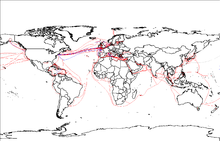
2007 map showing submarine optical fiber telecommunications cables around the world.
- An optical fiber is a drinking glass fiber. Information technology carries pulses of low-cal that represent data via lasers and optical amplifiers. Some advantages of optical fibers over metal wires are very depression transmission loss and immunity to electrical interference. Using dense wave division multiplexing, optical fibers can simultaneously carry multiple streams of data on different wavelengths of light, which greatly increases the rate that information can be sent to upward to trillions of $.25 per second. Optic fibers tin can be used for long runs of cable carrying very high data rates, and are used for undersea communications cables to interconnect continents. At that place are ii basic types of fiber eyes, single-mode optical fiber (SMF) and multi-mode optical cobweb (MMF). Single-mode cobweb has the advantage of being able to sustain a coherent signal for dozens or even a hundred kilometers. Multimode fiber is cheaper to terminate simply is limited to a few hundred or even just a few dozens of meters, depending on the data charge per unit and cablevision form.[thirty]
Wireless [edit]
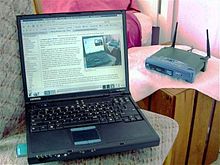
Computers are very ofttimes connected to networks using wireless links
Network connections tin can exist established wirelessly using radio or other electromagnetic means of communication.
- Terrestrial microwave – Terrestrial microwave communication uses Globe-based transmitters and receivers resembling satellite dishes. Terrestrial microwaves are in the low gigahertz range, which limits all communications to line-of-sight. Relay stations are spaced approximately 40 miles (64 km) apart.
- Communications satellites – Satellites also communicate via microwave. The satellites are stationed in space, typically in geosynchronous orbit 35,400 km (22,000 mi) in a higher place the equator. These Globe-orbiting systems are capable of receiving and relaying phonation, information, and TV signals.
- Cellular networks employ several radio communications technologies. The systems divide the region covered into multiple geographic areas. Each area is served past a depression-ability transceiver.
- Radio and spread spectrum technologies – Wireless LANs utilize a high-frequency radio technology similar to digital cellular. Wireless LANs use spread spectrum engineering to enable communication between multiple devices in a limited area. IEEE 802.11 defines a common flavour of open-standards wireless radio-wave technology known every bit Wi-Fi.
- Costless-space optical communication uses visible or invisible light for communications. In nearly cases, line-of-sight propagation is used, which limits the physical positioning of communicating devices.
- Extending the Internet to interplanetary dimensions via radio waves and optical ways, the Interplanetary Net.[31]
- IP over Avian Carriers was a humorous April fool'south Request for Comments, issued as RFC 1149. Information technology was implemented in real life in 2001.[32]
The terminal ii cases have a big round-trip delay time, which gives slow two-way communication but doesn't prevent sending large amounts of information (they tin have loftier throughput).
Network nodes [edit]
Apart from whatever concrete transmission media, networks are built from additional basic organisation edifice blocks, such as network interface controllers (NICs), repeaters, hubs, bridges, switches, routers, modems, and firewalls. Any item piece of equipment will frequently contain multiple building blocks and then may perform multiple functions.
Network interfaces [edit]
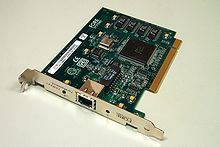
An ATM network interface in the form of an accessory card. A lot of network interfaces are built-in.
A network interface controller (NIC) is computer hardware that connects the calculator to the network media and has the ability to process low-level network data. For case, the NIC may have a connector for accepting a cable, or an aerial for wireless transmission and reception, and the associated circuitry.
In Ethernet networks, each network interface controller has a unique Media Access Control (MAC) accost—ordinarily stored in the controller'due south permanent memory. To avoid address conflicts between network devices, the Institute of Electrical and Electronics Engineers (IEEE) maintains and administers MAC accost uniqueness. The size of an Ethernet MAC address is half-dozen octets. The three near significant octets are reserved to identify NIC manufacturers. These manufacturers, using simply their assigned prefixes, uniquely assign the three least-significant octets of every Ethernet interface they produce.
Repeaters and hubs [edit]
A repeater is an electronic device that receives a network indicate, cleans it of unnecessary racket and regenerates it. The signal is retransmitted at a higher power level, or to the other side of obstruction so that the signal can cover longer distances without deposition. In almost twisted pair Ethernet configurations, repeaters are required for cable that runs longer than 100 meters. With fiber optics, repeaters tin be tens or fifty-fifty hundreds of kilometers autonomously.
Repeaters work on the physical layer of the OSI model but nevertheless crave a small amount of fourth dimension to regenerate the point. This tin can cause a propagation delay that affects network performance and may affect proper function. As a result, many network architectures limit the number of repeaters used in a network, eastward.chiliad., the Ethernet 5-4-iii rule.
An Ethernet repeater with multiple ports is known as an Ethernet hub. In addition to reconditioning and distributing network signals, a repeater hub assists with collision detection and fault isolation for the network. Hubs and repeaters in LANs have been largely obsoleted by modern network switches.
Bridges and switches [edit]
Network bridges and network switches are distinct from a hub in that they simply forward frames to the ports involved in the communication whereas a hub forwards to all ports.[33] Bridges only have 2 ports merely a switch can be idea of equally a multi-port span. Switches usually have numerous ports, facilitating a star topology for devices, and for cascading additional switches.
Bridges and switches operate at the data link layer (layer ii) of the OSI model and bridge traffic between 2 or more network segments to form a single local network. Both are devices that forward frames of data between ports based on the destination MAC accost in each frame.[34] They learn the association of physical ports to MAC addresses by examining the source addresses of received frames and but forward the frame when necessary. If an unknown destination MAC is targeted, the device broadcasts the request to all ports except the source, and discovers the location from the respond.
Bridges and switches divide the network's collision domain but maintain a single broadcast domain. Network segmentation through bridging and switching helps break down a large, congested network into an assemblage of smaller, more efficient networks.
Routers [edit]
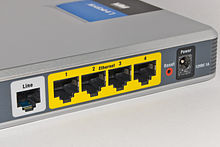
A typical home or small office router showing the ADSL telephone line and Ethernet network cable connections
A router is an internetworking device that forwards packets between networks by processing the addressing or routing information included in the packet. The routing information is ofttimes candy in conjunction with the routing tabular array. A router uses its routing table to make up one's mind where to forward packets and does not require broadcasting packets which is inefficient for very big networks.
Modems [edit]
Modems (modulator-demodulator) are used to connect network nodes via wire non originally designed for digital network traffic, or for wireless. To practise this i or more than carrier signals are modulated by the digital indicate to produce an analog betoken that can be tailored to give the required properties for transmission. Early modems modulated audio signals sent over a standard voice telephone line. Modems are still ordinarily used for telephone lines, using a digital subscriber line technology and cable television systems using DOCSIS technology.
Firewalls [edit]

A firewall is a network device or software for decision-making network security and access rules. Firewalls are inserted in connections between secure internal networks and potentially insecure external networks such equally the Internet. Firewalls are typically configured to reject access requests from unrecognized sources while allowing deportment from recognized ones. The vital role firewalls play in network security grows in parallel with the constant increase in cyber attacks.
Communication protocols [edit]

The TCP/IP model and its relation to common protocols used at unlike layers of the model.

Message flows between ii devices (A-B) at the four layers of the TCP/IP model in the presence of a router (R). Red flows are constructive communication paths, blackness paths are across the bodily network links.
A communication protocol is a set up of rules for exchanging information over a network. Communication protocols accept various characteristics. They may be connection-oriented or connectionless, they may utilise circuit way or packet switching, and they may use hierarchical addressing or flat addressing.
In a protocol stack, often constructed per the OSI model, communications functions are divided up into protocol layers, where each layer leverages the services of the layer below it until the everyman layer controls the hardware that sends information across the media. The use of protocol layering is ubiquitous beyond the field of computer networking. An of import example of a protocol stack is HTTP (the Globe Wide Web protocol) running over TCP over IP (the Internet protocols) over IEEE 802.11 (the Wi-Fi protocol). This stack is used between the wireless router and the home user's personal computer when the user is surfing the web.
There are many communication protocols, a few of which are described below.
Mutual protocols [edit]
Internet Protocol Suite [edit]
The Cyberspace Protocol Suite, also called TCP/IP, is the foundation of all modern networking. It offers connection-less and connection-oriented services over an inherently unreliable network traversed past datagram manual using Net protocol (IP). At its core, the protocol suite defines the addressing, identification, and routing specifications for Cyberspace Protocol Version 4 (IPv4) and for IPv6, the next generation of the protocol with a much enlarged addressing adequacy. The Net Protocol Suite is the defining ready of protocols for the Internet.[35]
IEEE 802 [edit]
IEEE 802 is a family unit of IEEE standards dealing with local area networks and metropolitan area networks. The complete IEEE 802 protocol suite provides a diverse gear up of networking capabilities. The protocols have a apartment addressing scheme. They operate mostly at layers 1 and 2 of the OSI model.
For instance, MAC bridging (IEEE 802.1D) deals with the routing of Ethernet packets using a Spanning Tree Protocol. IEEE 802.1Q describes VLANs, and IEEE 802.1X defines a port-based Network Access Command protocol, which forms the basis for the authentication mechanisms used in VLANs[36] (only it is likewise plant in WLANs[37]) – it is what the home user sees when the user has to enter a "wireless access primal".
Ethernet [edit]
Ethernet is a family of technologies used in wired LANs. Information technology is described by a set up of standards together called IEEE 802.three published by the Found of Electrical and Electronics Engineers.
Wireless LAN [edit]
Wireless LAN based on the IEEE 802.11 standards, besides widely known as WLAN or WiFi, is probably the most well-known member of the IEEE 802 protocol family for dwelling users today. IEEE 802.xi shares many properties with wired Ethernet.
SONET/SDH [edit]

Synchronous optical networking (SONET) and Synchronous Digital Bureaucracy (SDH) are standardized multiplexing protocols that transfer multiple digital bit streams over optical fiber using lasers. They were originally designed to ship circuit mode communications from a variety of dissimilar sources, primarily to support excursion-switched digital telephony. Nevertheless, due to its protocol neutrality and transport-oriented features, SONET/SDH as well was the obvious choice for transporting Asynchronous Transfer Mode (ATM) frames.
Asynchronous Transfer Mode [edit]

Asynchronous Transfer Mode
Asynchronous Transfer Fashion (ATM) is a switching technique for telecommunication networks. Information technology uses asynchronous fourth dimension-partition multiplexing and encodes data into small, stock-still-sized cells. This differs from other protocols such as the Internet Protocol Suite or Ethernet that use variable-sized packets or frames. ATM has similarities with both circuit and package switched networking. This makes it a good choice for a network that must handle both traditional high-throughput information traffic, and existent-fourth dimension, low-latency content such as voice and video. ATM uses a connection-oriented model in which a virtual excursion must exist established between 2 endpoints earlier the actual data exchange begins.
ATM still plays a part in the final mile, which is the connection betwixt an Internet service provider and the abode user.[38] [ needs update ]
Cellular standards [edit]
There are a number of dissimilar digital cellular standards, including: Global Organisation for Mobile Communications (GSM), Full general Packet Radio Service (GPRS), cdmaOne, CDMA2000, Development-Data Optimized (EV-DO), Enhanced Information Rates for GSM Evolution (EDGE), Universal Mobile Telecommunications System (UMTS), Digital Enhanced Cordless Telecommunications (DECT), Digital AMPS (IS-136/TDMA), and Integrated Digital Enhanced Network (iDEN).[39]
Routing [edit]
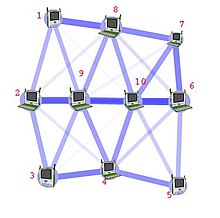
Routing calculates expert paths through a network for information to take. For example, from node 1 to node 6 the best routes are likely to be 1-8-7-6, 1-viii-ten-vi or one-nine-x-6, as these are the shortest routes.
Routing is the process of selecting network paths to carry network traffic. Routing is performed for many kinds of networks, including circuit switching networks and package switched networks.
In parcel-switched networks, routing protocols directly bundle forwarding through intermediate nodes. Intermediate nodes are typically network hardware devices such as routers, bridges, gateways, firewalls, or switches. General-purpose computers tin besides forward packets and perform routing, though considering they lack specialized hardware, may offering express performance. The routing procedure directs forwarding on the basis of routing tables, which maintain a tape of the routes to various network destinations. Most routing algorithms use only i network path at a time. Multipath routing techniques enable the employ of multiple alternative paths.
Routing can be contrasted with bridging in its assumption that network addresses are structured and that like addresses imply proximity inside the network. Structured addresses allow a single routing tabular array entry to represent the route to a group of devices. In large networks, the structured addressing used by routers outperforms unstructured addressing used by bridging. Structured IP addresses are used on the Cyberspace. Unstructured MAC addresses are used for bridging on Ethernet and like local area networks.
Geographic scale [edit]
Networks may be characterized past many properties or features, such as concrete capacity, organizational purpose, user dominance, admission rights, and others. Another distinct nomenclature method is that of the physical extent or geographic calibration.
- Nanoscale network
A nanoscale network has central components implemented at the nanoscale, including message carriers, and leverages physical principles that differ from macroscale communication mechanisms. Nanoscale communication extends communication to very small sensors and actuators such every bit those found in biological systems and too tends to operate in environments that would be too harsh for other communication techniques.[40]
- Personal area network
A personal area network (PAN) is a calculator network used for advice among computers and different data technological devices close to one person. Some examples of devices that are used in a PAN are personal computers, printers, fax machines, telephones, PDAs, scanners, and video game consoles. A PAN may include wired and wireless devices. The reach of a PAN typically extends to 10 meters.[41] A wired PAN is normally constructed with USB and FireWire connections while technologies such equally Bluetooth and infrared advice typically form a wireless PAN.
- Local area network
A local area network (LAN) is a network that connects computers and devices in a limited geographical area such equally a domicile, school, role building, or closely positioned group of buildings. Wired LANs are near commonly based on Ethernet technology. Other networking technologies such as ITU-T Thousand.hn also provide a manner to create a wired LAN using existing wiring, such as coaxial cables, telephone lines, and power lines.[42]
A LAN can be connected to a wide surface area network (WAN) using a router. The defining characteristics of a LAN, in dissimilarity to a WAN, include higher data transfer rates, express geographic range, and lack of reliance on leased lines to provide connectivity.[ citation needed ] Electric current Ethernet or other IEEE 802.3 LAN technologies operate at data transfer rates up to and in excess of 100 Gbit/s,[43] standardized by IEEE in 2010.
- Home area network
A habitation surface area network (HAN) is a residential LAN used for communication between digital devices typically deployed in the dwelling house, normally a small number of personal computers and accessories, such as printers and mobile calculating devices. An of import office is the sharing of Cyberspace access, ofttimes a broadband service through a cablevision Internet access or digital subscriber line (DSL) provider.
- Storage surface area network
A storage expanse network (SAN) is a dedicated network that provides access to consolidated, cake-level data storage. SANs are primarily used to make storage devices, such equally disk arrays, record libraries, and optical jukeboxes, accessible to servers then that the storage appears as locally attached devices to the operating system. A SAN typically has its ain network of storage devices that are by and large non accessible through the local area network by other devices. The toll and complication of SANs dropped in the early 2000s to levels assuasive wider adoption beyond both enterprise and small-scale to medium-sized business environments.[ citation needed ]
- Campus surface area network
A campus area network (Tin) is made up of an interconnection of LANs within a express geographical area. The networking equipment (switches, routers) and transmission media (optical cobweb, copper establish, Cat5 cabling, etc.) are almost entirely owned by the campus tenant/possessor (an enterprise, university, government, etc.).
For case, a academy campus network is likely to link a variety of campus buildings to connect academic colleges or departments, the library, and student residence halls.
- Backbone network
A backbone network is part of a computer network infrastructure that provides a path for the exchange of information between different LANs or subnetworks. A backbone can tie together various networks within the same building, across unlike buildings, or over a wide area.
For example, a large company might implement a backbone network to connect departments that are located around the earth. The equipment that ties together the departmental networks constitutes the network courage. When designing a network backbone, network functioning and network congestion are critical factors to take into account. Normally, the backbone network's capacity is greater than that of the individual networks connected to it.
Another example of a backbone network is the Internet courage, which is a massive, global system of fiber-optic cable and optical networking that comport the bulk of information between wide expanse networks (WANs), metro, regional, national and transoceanic networks.
- Metropolitan area network
A metropolitan area network (MAN) is a large computer network that usually spans a metropolis or a big campus.
- Wide expanse network
A wide area network (WAN) is a computer network that covers a big geographic area such as a urban center, country, or spans fifty-fifty intercontinental distances. A WAN uses a communications channel that combines many types of media such equally telephone lines, cables, and airwaves. A WAN oftentimes makes use of transmission facilities provided by common carriers, such as phone companies. WAN technologies more often than not function at the lower three layers of the OSI reference model: the physical layer, the information link layer, and the network layer.
- Enterprise private network
An enterprise private network is a network that a unmarried organization builds to interconnect its function locations (e.k., production sites, head offices, remote offices, shops) then they tin can share computer resources.
- Virtual private network
A virtual private network (VPN) is an overlay network in which some of the links between nodes are carried by open up connections or virtual circuits in some larger network (e.one thousand., the Cyberspace) instead of past physical wires. The data link layer protocols of the virtual network are said to exist tunneled through the larger network when this is the example. One common application is secure communications through the public Internet, but a VPN need not have explicit security features, such equally authentication or content encryption. VPNs, for example, tin can be used to separate the traffic of unlike user communities over an underlying network with strong security features.
VPN may have best-try functioning or may have a divers service level understanding (SLA) between the VPN customer and the VPN service provider. Generally, a VPN has a topology more complex than point-to-point.
- Global area network
A global surface area network (GAN) is a network used for supporting mobile across an arbitrary number of wireless LANs, satellite coverage areas, etc. The key challenge in mobile communications is handing off user communications from 1 local coverage expanse to the side by side. In IEEE Project 802, this involves a succession of terrestrial wireless LANs.[44]
Organizational scope [edit]
Networks are typically managed by the organizations that ain them. Individual enterprise networks may utilize a combination of intranets and extranets. They may also provide network access to the Net, which has no single owner and permits virtually unlimited global connectivity.
Intranet [edit]
An intranet is a prepare of networks that are nether the command of a single authoritative entity. The intranet uses the IP protocol and IP-based tools such as web browsers and file transfer applications. The authoritative entity limits the utilise of the intranet to its authorized users. Nearly unremarkably, an intranet is the internal LAN of an organization. A large intranet typically has at least 1 web server to provide users with organizational information. An intranet is also anything backside the router on a local surface area network.
[edit]
An extranet is a network that is as well under the administrative control of a single arrangement but supports a limited connection to a specific external network. For example, an organization may provide access to some aspects of its intranet to share data with its business partners or customers. These other entities are not necessarily trusted from a security standpoint. Network connection to an extranet is often, but not always, implemented via WAN technology.
Internet [edit]
An internetwork is the connection of multiple different types of computer networks to grade a single computer network by layering on top of the different networking software and connecting them together using routers.
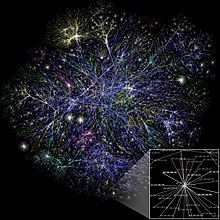
Partial map of the Net, based on the January 15, 2005 data establish on opte.org Archived 2005-01-xv at the Wayback Machine. Each line is fatigued between ii nodes, representing 2 IP addresses. The length of the lines is indicative of the delay betwixt those two nodes. This graph represents less than 30% of the Class C networks reachable.
The Net is the largest example of internetwork. It is a global arrangement of interconnected governmental, academic, corporate, public, and private computer networks. Information technology is based on the networking technologies of the Internet Protocol Suite. It is the successor of the Advanced Research Projects Agency Network (ARPANET) developed by DARPA of the United States Department of Defense. The Internet utilizes copper communications and the optical networking backbone to enable the World Wide Web (Www), the Internet of Things, video transfer, and a broad range of information services.
Participants on the Internet use a diverse assortment of methods of several hundred documented, and often standardized, protocols uniform with the Internet Protocol Suite and an addressing organization (IP addresses) administered by the Internet Assigned Numbers Authority and accost registries. Service providers and large enterprises exchange information well-nigh the reachability of their address spaces through the Edge Gateway Protocol (BGP), forming a redundant worldwide mesh of transmission paths.
Darknet [edit]
A darknet is an overlay network, typically running on the Internet, that is only attainable through specialized software. A darknet is an anonymizing network where connections are fabricated simply betwixt trusted peers — sometimes called "friends" (F2F)[45] — using non-standard protocols and ports.
Darknets are distinct from other distributed peer-to-peer networks as sharing is bearding (that is, IP addresses are non publicly shared), and therefore users can communicate with piffling fear of governmental or corporate interference.[46]
Network service [edit]
Network services are applications hosted by servers on a computer network, to provide some functionality for members or users of the network, or to help the network itself to operate.
The Earth Wide Spider web, E-mail,[47] press and network file sharing are examples of well-known network services. Network services such as DNS (Domain Name System) give names for IP and MAC addresses (people remember names like "nm.lan" ameliorate than numbers like "210.121.67.18"),[48] and DHCP to ensure that the equipment on the network has a valid IP address.[49]
Services are normally based on a service protocol that defines the format and sequencing of messages betwixt clients and servers of that network service.
Network performance [edit]
Bandwidth [edit]
Bandwidth in chip/s may refer to consumed bandwidth, corresponding to achieved throughput or goodput, i.due east., the average charge per unit of successful data transfer through a communication path. The throughput is affected past technologies such every bit bandwidth shaping, bandwidth management, bandwidth throttling, bandwidth cap, bandwidth allocation (for example bandwidth allocation protocol and dynamic bandwidth allocation), etc. A fleck stream's bandwidth is proportional to the average consumed signal bandwidth in hertz (the boilerplate spectral bandwidth of the analog signal representing the bit stream) during a studied time interval.
Network filibuster [edit]
Network filibuster is a design and performance characteristic of a telecommunications network. Information technology specifies the latency for a bit of data to travel across the network from 1 communication endpoint to another. It is typically measured in multiples or fractions of a second. Filibuster may differ slightly, depending on the location of the specific pair of communicating endpoints. Engineers normally report both the maximum and boilerplate filibuster, and they split the delay into several parts:
- Processing delay – time information technology takes a router to process the parcel header
- Queuing delay – time the packet spends in routing queues
- Transmission delay – time it takes to button the packet's $.25 onto the link
- Propagation delay – fourth dimension for a signal to propagate through the media
A sure minimum level of delay is experienced by signals due to the time information technology takes to transmit a package serially through a link. This delay is extended by more than variable levels of filibuster due to network congestion. IP network delays can range from a few milliseconds to several hundred milliseconds.
Quality of service [edit]
Depending on the installation requirements, network operation is usually measured past the quality of service of a telecommunications product. The parameters that affect this typically can include throughput, jitter, chip mistake rate and latency.
The following list gives examples of network functioning measures for a circuit-switched network and one type of packet-switched network, viz. ATM:
- Circuit-switched networks: In circuit switched networks, network performance is synonymous with the course of service. The number of rejected calls is a measure out of how well the network is performing nether heavy traffic loads.[l] Other types of performance measures tin include the level of noise and repeat.
- ATM: In an Asynchronous Transfer Mode (ATM) network, performance can be measured by line rate, quality of service (QoS), data throughput, connect time, stability, technology, modulation technique, and modem enhancements.[51] [ verification needed ] [ total citation needed ]
There are many ways to measure the performance of a network, every bit each network is different in nature and pattern. Operation can also be modeled instead of measured. For example, state transition diagrams are often used to model queuing performance in a circuit-switched network. The network planner uses these diagrams to analyze how the network performs in each state, ensuring that the network is optimally designed.[52]
Network congestion [edit]
Network congestion occurs when a link or node is subjected to a greater information load than information technology is rated for, resulting in a deterioration of its quality of service. When networks are congested and queues become as well full, packets have to exist discarded, and and then networks rely on re-transmission. Typical effects of congestion include queueing filibuster, parcel loss or the blocking of new connections. A issue of these latter two is that incremental increases in offered load lead either to only a small increase in the network throughput or to a reduction in network throughput.
Network protocols that use ambitious retransmissions to compensate for bundle loss tend to keep systems in a state of network congestion—even after the initial load is reduced to a level that would non unremarkably induce network congestion. Thus, networks using these protocols can exhibit ii stable states nether the same level of load. The stable country with low throughput is known as congestive collapse.
Modern networks use congestion command, congestion avoidance and traffic control techniques to try to avoid congestion plummet (i.e. endpoints typically slow down or sometimes even cease manual entirely when the network is congested). These techniques include: exponential backoff in protocols such every bit 802.11'southward CSMA/CA and the original Ethernet, window reduction in TCP, and off-white queueing in devices such every bit routers. Another method to avoid the negative furnishings of network congestion is implementing priority schemes so that some packets are transmitted with higher priority than others. Priority schemes do not solve network congestion by themselves, just they assist to alleviate the effects of congestion for some services. An example of this is 802.1p. A 3rd method to avoid network congestion is the explicit allotment of network resources to specific flows. Ane example of this is the utilize of Contention-Free Transmission Opportunities (CFTXOPs) in the ITU-T G.hn standard, which provides high-speed (upwardly to one Gbit/s) Local area networking over existing home wires (ability lines, phone lines and coaxial cables).
For the Internet, RFC 2914 addresses the bailiwick of congestion control in item.
Network resilience [edit]
Network resilience is "the ability to provide and maintain an acceptable level of service in the face of faults and challenges to normal functioning."[53]
Security [edit]
Computer networks are also used by security hackers to deploy computer viruses or computer worms on devices continued to the network, or to forestall these devices from accessing the network via a denial-of-service attack.
Network security [edit]
Network Security consists of provisions and policies adopted past the network administrator to preclude and monitor unauthorized access, misuse, modification, or deprival of the calculator network and its network-accessible resources.[54] Network security is the authorization of access to information in a network, which is controlled by the network ambassador. Users are assigned an ID and countersign that allows them access to information and programs within their authority. Network security is used on a variety of reckoner networks, both public and private, to secure daily transactions and communications among businesses, government agencies, and individuals.
Network surveillance [edit]
Network surveillance is the monitoring of data being transferred over reckoner networks such every bit the Net. The monitoring is often washed surreptitiously and may be done by or at the behest of governments, by corporations, criminal organizations, or individuals. It may or may not be legal and may or may non crave authorization from a court or other independent bureau.
Reckoner and network surveillance programs are widespread today, and almost all Cyberspace traffic is or could potentially exist monitored for clues to illegal activity.
Surveillance is very useful to governments and law enforcement to maintain social control, recognize and monitor threats, and prevent/investigate criminal activity. With the appearance of programs such every bit the Full Information Awareness program, technologies such equally loftier-speed surveillance computers and biometrics software, and laws such every bit the Communications Assistance For Law Enforcement Act, governments now possess an unprecedented power to monitor the activities of citizens.[55]
However, many civil rights and privacy groups—such as Reporters Without Borders, the Electronic Frontier Foundation, and the American Civil Liberties Wedlock—have expressed business organization that increasing surveillance of citizens may lead to a mass surveillance gild, with limited political and personal freedoms. Fears such every bit this accept led to numerous lawsuits such as Hepting v. AT&T.[55] [56] The hacktivist group Anonymous has hacked into regime websites in protestation of what information technology considers "draconian surveillance".[57] [58]
Cease to end encryption [edit]
End-to-cease encryption (E2EE) is a digital communications image of uninterrupted protection of data traveling between two communicating parties. It involves the originating party encrypting data so simply the intended recipient tin can decrypt it, with no dependency on third parties. End-to-end encryption prevents intermediaries, such as Internet providers or application service providers, from discovering or tampering with communications. Finish-to-end encryption generally protects both confidentiality and integrity.
Examples of end-to-terminate encryption include HTTPS for web traffic, PGP for e-mail, OTR for instant messaging, ZRTP for telephony, and TETRA for radio.
Typical server-based communications systems practice non include terminate-to-end encryption. These systems can simply guarantee the protection of communications between clients and servers, not between the communicating parties themselves. Examples of not-E2EE systems are Google Talk, Yahoo Messenger, Facebook, and Dropbox. Some such systems, for example, LavaBit and SecretInk, have even described themselves every bit offering "end-to-end" encryption when they practise not. Some systems that usually offer end-to-end encryption have turned out to contain a back door that subverts negotiation of the encryption key between the communicating parties, for example Skype or Hushmail.
The end-to-end encryption prototype does not directly address risks at the endpoints of the communication themselves, such as the technical exploitation of clients, poor quality random number generators, or key escrow. E2EE also does not address traffic analysis, which relates to things such as the identities of the endpoints and the times and quantities of messages that are sent.
SSL/TLS [edit]
The introduction and rapid growth of e-commerce on the World wide web in the mid-1990s fabricated information technology obvious that some form of hallmark and encryption was needed. Netscape took the first shot at a new standard. At the time, the ascendant web browser was Netscape Navigator. Netscape created a standard called secure socket layer (SSL). SSL requires a server with a certificate. When a client requests access to an SSL-secured server, the server sends a copy of the certificate to the client. The SSL customer checks this certificate (all web browsers come with an exhaustive list of CA root certificates preloaded), and if the certificate checks out, the server is authenticated and the customer negotiates a symmetric-cardinal nix for employ in the session. The session is at present in a very secure encrypted tunnel betwixt the SSL server and the SSL client.[30]
Views of networks [edit]
Users and network administrators typically take different views of their networks. Users tin can share printers and some servers from a workgroup, which usually ways they are in the same geographic location and are on the same LAN, whereas a Network Administrator is responsible to keep that network up and running. A customs of interest has less of a connection of being in a local expanse and should be thought of as a set of arbitrarily located users who share a set of servers, and possibly too communicate via peer-to-peer technologies.
Network administrators can see networks from both concrete and logical perspectives. The physical perspective involves geographic locations, physical cabling, and the network elements (eastward.g., routers, bridges and awarding layer gateways) that interconnect via the transmission media. Logical networks, chosen, in the TCP/IP architecture, subnets, map onto ane or more than manual media. For example, a common exercise in a campus of buildings is to brand a gear up of LAN cables in each building announced to be a mutual subnet, using VLAN engineering science.
Both users and administrators are enlightened, to varying extents, of the trust and telescopic characteristics of a network. Once more using TCP/IP architectural terminology, an intranet is a community of interest nether private administration usually by an enterprise, and is only accessible by authorized users (e.k. employees).[59] Intranets exercise not have to be connected to the Internet, but generally have a limited connection. An extranet is an extension of an intranet that allows secure communications to users outside of the intranet (east.g. business partners, customers).[59]
Unofficially, the Cyberspace is the set of users, enterprises, and content providers that are interconnected past Internet Service Providers (ISP). From an engineering viewpoint, the Net is the set of subnets, and aggregates of subnets, that share the registered IP address infinite and exchange data about the reachability of those IP addresses using the Border Gateway Protocol. Typically, the human-readable names of servers are translated to IP addresses, transparently to users, via the directory function of the Domain Name System (DNS).
Over the Net, there can be business-to-concern (B2B), business-to-consumer (B2C) and consumer-to-consumer (C2C) communications. When money or sensitive information is exchanged, the communications are apt to be protected by some form of communications security machinery. Intranets and extranets can be securely superimposed onto the Internet, without any access by general Net users and administrators, using secure Virtual Private Network (VPN) engineering science.
Journals and newsletters [edit]
- Open Figurer Science (open up access journal)
See too [edit]
- Comparing of network diagram software
- Net
- History of the Internet
- Data Historic period
- Data revolution
- ISO/IEC 11801 – International standard for electric and optical cables
- Minimum-Pairs Protocol
- Network simulation
- Network planning and design
- Network traffic control
References [edit]
- ^ Corbató, F. J.; et al. (1963). The Compatible Time-Sharing System A Programmer'due south Guide] (PDF). MIT Press. ISBN978-0-262-03008-three.
Shortly after the first paper on time-shared computers by C. Strachey at the June 1959 UNESCO Information Processing conference, H. Yard. Teager and J. McCarthy at MIT delivered an unpublished paper "Fourth dimension-shared Program Testing" at the August 1959 ACM Meeting.
- ^ "Computer Pioneers - Christopher Strachey". history.reckoner.org . Retrieved 2020-01-23 .
- ^ "Reminiscences on the Theory of Time-Sharing". jmc.stanford.edu . Retrieved 2020-01-23 .
- ^ "Computer - Fourth dimension-sharing and minicomputers". Encyclopedia Britannica . Retrieved 2020-01-23 .
- ^ Gillies, James M.; Gillies, James; Gillies, James and Cailliau Robert; Cailliau, R. (2000). How the Web was Built-in: The Story of the World wide web . Oxford University Press. pp. 13. ISBN978-0-19-286207-5.
- ^ Kitova, O. "Kitov Anatoliy Ivanovich. Russian Virtual Computer Museum". computer-museum.ru. Translated by Alexander Nitusov. Retrieved 2021-10-eleven .
- ^ Peters, Benjamin (25 March 2016). How Not to Network a Nation: The Uneasy History of the Soviet Internet. ISBN978-0262034180.
- ^ Isaacson, Walter (2014). The Innovators: How a Group of Hackers, Geniuses, and Geeks Created the Digital Revolution. Simon and Schuster. pp. 237–246. ISBN9781476708690.
- ^ "NIHF Inductee Paul Baran, Who Invented Packet Switching". National Inventors Hall of Fame. Retrieved 2022-02-12 .
- ^ "NIHF Inductee Donald Davies, Who Invented Bundle Switching". National Inventors Hall of Fame. Retrieved 2022-02-12 .
- ^ a b Roberts, Lawrence Grand. (November 1978). "The development of packet switching" (PDF). Proceedings of the IEEE. 66 (11): 1307–13. doi:10.1109/PROC.1978.11141. S2CID 26876676.
Both Paul Baran and Donald Davies in their original papers anticipated the utilize of T1 trunks
- ^ Cambell-Kelly, Martin (1987). "Data Communications at the National Concrete Laboratory (1965-1975)". Annals of the History of Calculating. 9 (3/4): 221–247. doi:x.1109/MAHC.1987.10023. S2CID 8172150.
Transmission of packets of information over the high-speed lines
- ^ Guardian Staff (2013-06-25). "Internet pioneers airbrushed from history". The Guardian. ISSN 0261-3077. Retrieved 2020-07-31 .
This was the beginning digital local network in the world to use packet switching and high-speed links.
- ^ Chris Sutton. "Internet Began 35 Years Ago at UCLA with Offset Message Ever Sent Between Ii Computers". UCLA. Archived from the original on 2008-03-08.
- ^ Gillies, James; Cailliau, Robert (2000). How the Web was Born: The Story of the World wide web . Oxford University Press. p. 25. ISBN0192862073.
- ^ C. Hempstead; W. Worthington (2005). Encyclopedia of 20th-Century Engineering science. Routledge. ISBN9781135455514.
- ^ Alarcia, G.; Herrera, S. (1974). "C.T.Northward.Due east.'s Bundle SWITCHING NETWORK. ITS APPLICATIONS". Proceedings of 2nd ICCC 74. pp. 163–170. Archived from the original on 2021-04-xiv.
- ^ Cuenca, L. (1980). "A PUBLIC PACKET SWITCHING Data COMMUNICATIONS NETWORK: EIGHT YEARS OF OPERATING EXPERIENCE". Conference Record of ICC 80. IEEE. pp. 39.iii.1–39.3.5. Archived from the original on 2021-04-14.
- ^ Lavandera, Luis (1980). "Compages, PROTOCOLS AND Operation OF RETD". Conference Tape of ICC 80. IEEE. pp. 28.four.ane–28.iv.5. Archived from the original on 2021-04-xiv.
- ^ Quango, National Inquiry; Sciences, Sectionalization on Engineering science and Physical; Board, Computer Science and Telecommunications; Applications, Commission on Physical Sciences, Mathematics, and; Committee, NII 2000 Steering (1998-02-05). The Unpredictable Certainty: White Papers. National Academies Press. ISBN978-0-309-17414-v.
- ^ Bennett, Richard (September 2009). "Designed for Alter: End-to-End Arguments, Internet Innovation, and the Net Neutrality Debate" (PDF). It and Innovation Foundation. p. 11. Archived from the original (PDF) on 2019-08-29. Retrieved 2017-09-eleven .
- ^ Robert Chiliad. Metcalfe; David R. Boggs (July 1976). "Ethernet: Distributed Package Switching for Local Computer Networks". Communications of the ACM. 19 (5): 395–404. doi:10.1145/360248.360253. S2CID 429216. Archived from the original on 2007-08-07.
- ^ Cerf, Vinton; dalal, Yogen; Sunshine, Carl (December 1974). Specification of Internet Transmission Control Protocol. IETF. doi:x.17487/RFC0675. RFC 675.
- ^ Pelkey, James Fifty. (2007). "six.ix – Metcalfe Joins the Systems Development Sectionalization of Xerox 1975-1978". Entrepreneurial Capitalism and Innovation: A History of Calculator Communications, 1968-1988 . Retrieved 2019-09-05 .
- ^ a b Spurgeon, Charles E. (2000). Ethernet The Definitive Guide . O'Reilly & Associates. ISBN1-56592-660-9.
- ^ "Introduction to Ethernet Technologies". www.wband.com. WideBand Products. Retrieved 2018-04-09 .
- ^ Pelkey, James L. (2007). "Yogen Dalal". Entrepreneurial Capitalism and Innovation: A History of Computer Communications, 1968-1988 . Retrieved 2019-09-05 .
- ^ a b D. Andersen; H. Balakrishnan; M. Kaashoek; R. Morris (Oct 2001), Resilient Overlay Networks, Association for Calculating Mechanism, retrieved 2011-11-12
- ^ "End System Multicast". project web site. Carnegie Mellon Academy. Archived from the original on 2005-02-21. Retrieved 2013-05-25 .
- ^ a b Meyers, Mike (2012). CompTIA Network+ exam guide : (Test N10-005) (5th ed.). New York: McGraw-Colina. ISBN9780071789226. OCLC 748332969.
- ^ A. Hooke (September 2000), Interplanetary Internet (PDF), 3rd Annual International Symposium on Advanced Radio Technologies, archived from the original (PDF) on 2012-01-13, retrieved 2011-11-12
- ^ "Bergen Linux User Group's CPIP Implementation". Blug.linux.no. Retrieved 2014-03-01 .
- ^ Bradley Mitchell. "bridge – network bridges". About.com. Archived from the original on 2008-03-28.
- ^ "Define switch". webopedia. September 1996. Retrieved 2008-04-08 .
- ^ Tanenbaum, Andrew S. (2003). Computer Networks (quaternary ed.). Prentice Hall.
- ^ IEEE 802.1X. IEEE STD 802.1X-2020 (Revision of IEEE STD 802.1X-2010 Incorporating IEEE STD 802.1Xbx-2014 and IEEE STD 802.1Xck-2018). February 2020. 7.1.iii Connectivity to unauthenticated systems. doi:10.1109/IEEESTD.2020.9018454. ISBN978-1-5044-6440-6.
- ^ IEEE 802.xi. IEEE STD 802.eleven-2020 (Revision of IEEE STD 802.xi-2016). February 2021. 4.two.5 Interaction with other IEEE 802 layers. doi:10.1109/IEEESTD.2021.9363693. ISBN978-1-5044-7283-8.
- ^ Martin, Thomas. "Pattern Principles for DSL-Based Access Solutions" (PDF). Archived from the original (PDF) on 2011-07-22.
- ^ Paetsch, Michael (1993). The development of mobile communications in the US and Europe: Regulation, engineering science, and markets. Boston, London: Artech Firm. ISBN978-0-8900-6688-one.
- ^ Bush, South. F. (2010). Nanoscale Communication Networks. Artech House. ISBN978-1-60807-003-9.
- ^ Margaret Rouse. "personal area network (PAN)". TechTarget . Retrieved 2011-01-29 .
- ^ "New global standard for fully networked home". ITU-T Newslog. ITU. 2008-12-12. Archived from the original on 2009-02-21. Retrieved 2011-11-12 .
- ^ "IEEE P802.3ba 40Gb/southward and 100Gb/due south Ethernet Task Force". IEEE 802.3 ETHERNET WORKING GROUP . Retrieved 2011-11-12 .
- ^ "IEEE 802.xx Mission and Project Telescopic". IEEE 802.20 — Mobile Broadband Wireless Access (MBWA) . Retrieved 2011-11-12 .
- ^ Mansfield-Devine, Steve (December 2009). "Darknets". Figurer Fraud & Security. 2009 (12): 4–6. doi:10.1016/S1361-3723(09)70150-2.
- ^ Wood, Jessica (2010). "The Darknet: A Digital Copyright Revolution" (PDF). Richmond Journal of Law and Technology. xvi (four). Retrieved 2011-x-25 .
- ^ Klensin, J. (October 2008). Simple Mail Transfer Protocol. doi:10.17487/RFC5321. RFC 5321.
- ^ Mockapetris, P. (Nov 1987). Domain names – Implementation and Specification. doi:10.17487/RFC1035. RFC 1035.
- ^ Peterson, Fifty.L.; Davie, B.South. (2011). Reckoner Networks: A Systems Approach (5th ed.). Elsevier. p. 372. ISBN978-0-1238-5060-7.
- ^ ITU-D Study Grouping 2 (June 2006). Teletraffic Technology Handbook (PDF). Archived from the original (PDF) on 2007-01-11.
- ^ Telecommunications Magazine Online, Americas January 2003, Issue Highlights, Online Exclusive: Broadband Access Maximum Functioning, Retrieved on February xiii, 2005.
- ^ "Land Transition Diagrams". Archived from the original on 2003-x-15. Retrieved 2003-07-13 .
- ^ "Definitions: Resilience". ResiliNets Research Initiative. Retrieved 2011-11-12 .
- ^ Simmonds, A; Sandilands, P; van Ekert, L (2004). An Ontology for Network Security Set on. Lecture Notes in Computer science. Vol. 3285. pp. 317–323. doi:ten.1007/978-3-540-30176-9_41. ISBN978-three-540-23659-seven. S2CID 2204780.
- ^ a b "Is the U.South. Turning Into a Surveillance Order?". American Civil Liberties Union. Retrieved 2009-03-xiii .
- ^ Jay Stanley; Barry Steinhardt (January 2003). "Bigger Monster, Weaker Chains: The Growth of an American Surveillance Society" (PDF). American Ceremonious Liberties Union. Retrieved 2009-03-xiii .
- ^ Emil Protalinski (2012-04-07). "Anonymous hacks Uk government sites over 'draconian surveillance'". ZDNet . Retrieved 12 March 2013.
- ^ James Brawl (2012-04-20). "Hacktivists in the frontline boxing for the internet". The Guardian . Retrieved 2012-06-17 .
- ^ a b Rosen, Due east.; Rekhter, Y. (March 1999). BGP/MPLS VPNs. doi:10.17487/RFC2547. RFC 2547.
 This article incorporates public domain fabric from Federal Standard 1037C. General Services Assistants. Archived from the original on 2022-01-22.
Further reading [edit]
- Shelly, Gary, et al. "Discovering Computers" 2003 Edition.
- Wendell Odom, Rus Healy, Denise Donohue. (2010) CCIE Routing and Switching. Indianapolis, IN: Cisco Printing
- Kurose James F and Keith W. Ross: Computer Networking: A Pinnacle-Downward Approach Featuring the Internet, Pearson Education 2005.
- William Stallings, Computer Networking with Internet Protocols and Technology, Pearson Education 2004.
- Important publications in estimator networks
- Network Advice Compages and Protocols: OSI Network Architecture seven Layers Model
- Dimitri Bertsekas, and Robert Gallager, "Information Networks," Prentice Hall, 1992.
External links [edit]
- Networking at Curlie
- IEEE Ethernet manufacturer data
- A computer networking acronym guide

15 By 15 Coordinate Grid,
Source: https://en.wikipedia.org/wiki/Computer_network
Posted by: crispincupong.blogspot.com
0 Response to "15 By 15 Coordinate Grid"
Post a Comment