

Write Pqqqqrr In Exponential Form
Yous might not have noticed that in all of the examples we have considered so far in this lesson, every p.d.f. or p.thousand.f. could nosotros written in what is often chosen exponential course, that is:
\( f(x;\theta) =exp\left[One thousand(x)p(\theta) + S(x) + q(\theta) \right] \)
with
- \(K(ten)\) and \(S(x)\) beingness functions only of \(x\),
- \(p(\theta)\) and \(q(\theta)\) existence functions simply of the parameter \(\theta\)
- The support existence free of the parameter \(\theta\).
First, nosotros had Bernoulli random variables with p.thou.f. written in exponential form as:
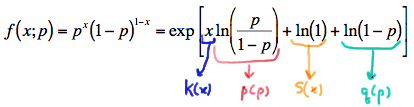
with:
- \(Thousand(10)\) and \(Due south(ten)\) being functions merely of \(x\),
- \(p(p)\) and \(q(p)\) being functions only of the parameter \(p\)
- The back up \(ten=0\), 1 not depending on the parameter \(p\)
Okay, we just skipped a lot of steps in that 2d equality sign, that is, in getting from betoken A (the typical p.g.f.) to betoken B (the p.thousand.f. written in exponential form). So, allow's take a look at that more than closely. We start with:
\( f(ten;p) =p^x(1-p)^{1-x} \)
Is the p.m.f. in exponential form? Doesn't look like information technology to me! We conspicuously need an "exp" to appear upwardly front. The only way we are going to get that without changing the underlying function is by taking the changed office, that is, the natural log ("ln"), at the same time. Doing so, we go:
\( f(x;p) =exp\left[\text{ln}(p^10(ane-p)^{ane-ten}) \right] \)
Is the p.m.f. now in exponential form? Nope, not notwithstanding, merely at to the lowest degree information technology's looking more hopeful. All of the steps that follow now involve using what nosotros know well-nigh the properties of logarithms. Recognizing that the natural log of a product is the sum of the natural logs, we get:
\( f(10;p) =exp\left[\text{ln}(p^x) + \text{ln}(ane-p)^{one-x} \right] \)
Is the p.yard.f. now in exponential form? Nope, still non yet, considering \(K(x)\), \(p(p)\), \(S(x)\), and \(q(p)\) can't notwithstanding exist identified every bit following exponential class, simply we are certainly getting closer. Recognizing that the log of a power is the ability times the log of the base, nosotros get:
\( f(x;p) =exp\left[ten\text{ln}(p) + (1-x)\text{ln}(i-p) \right] \)
This is getting tiring. Is the p.m.f. in exponential grade yet? Nope, agape not yet. Let'southward distribute that \((1-x)\) in that last term. Doing so, nosotros become:
\( f(x;p) =exp\left[ten\text{ln}(p) + \text{ln}(ane-p) - x\text{ln}(1-p) \right] \)
Is the p.m.f. now in exponential form? Allow's take a closer look. Well, in the showtime term, nosotros can identify the \(K(ten)p(p)\) and in the heart term, we see a role that depends but on the parameter \(p\):
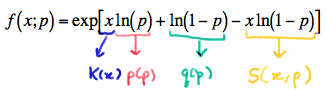
At present, all we need is the last term to depend only on \(x\) and we're every bit good every bit gilded. Oh, rats! The last term depends on both \(10\) and \(p\). So back to work some more! Recognizing that the log of a quotient is the difference between the logs of the numerator and denominator, we get:
\( f(10;p) =exp\left[ten\text{ln}\left( \frac{p}{1-p}\right) + \text{ln}(1-p) \right] \)
Is the p.yard.f. now in exponential form? So close! Let's just add 0 in (by style of the natural log of 1) to make it obvious. Doing and so, we become:
\( f(x;p) =exp\left[10\text{ln}\left( \frac{p}{one-p}\right) + \text{ln}(ane) + \text{ln}(one-p) \correct] \)
Aye, we have finally written the Bernoulli p.1000.f. in exponential form:
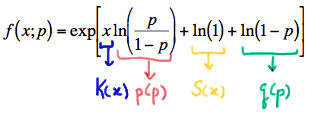
Whew! So, nosotros've fully explored writing the Bernoulli p.m.f. in exponential form! Let's get dorsum to reviewing all of the p.grand.f.'s we've encountered in this lesson. We had Poisson random variables whose p.m.f. can exist written in exponential form as:
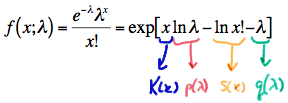
with
- \(G(ten)\) and \(S(x)\) beingness functions only of \(ten\),
- \(p(\lambda)\) and \(q(\lambda)\) being functions only of the parameter \(\lambda\)
- The support \(x = 0, 1, 2, \ldots\) not depending on the parameter \(\lambda\)
Then, we had \(N(\mu, ane)\) random variables whose p.d.f. tin be written in exponential class as:
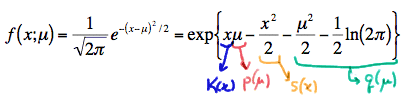
with
- \(K(ten)\) and \(S(10)\) existence functions only of \(10\),
- \(p(\mu)\) and \(q(\mu)\) being functions just of the parameter \(\mu\)
- The back up \(-\infty<x<\infty\) not depending on the parameter \(\mu\)
Then, we had exponential random variables random variables whose p.d.f. tin can be written in exponential form every bit:
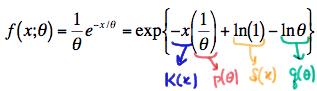
with
- \(K(x)\) and \(Due south(10)\) being functions just of \(x\),
- \(p(\theta)\) and \(q(\theta)\) being functions just of the parameter \(\theta\)
- The support \(x\ge 0\) not depending on the parameter \(\theta\).
Happily, it turns out that writing p.d.f.s and p.m.f.s in exponential form provides us yet a third way of identifying sufficient statistics for our parameters. The following theorem tells us how.
Theorem
Exponential Criterion:
Let \(X_1, X_2, \ldots, X_n\) be a random sample from a distribution with a p.d.f. or p.yard.f. of the exponential form:
\( f(x;\theta) =exp\left[G(x)p(\theta) + Southward(x) + q(\theta) \right] \)
with a support that does not depend on \(\theta\). Then, the statistic:
\( \sum_{i=ane}^{n} K(X_i) \)
is sufficient for \(\theta\).
Proof
Because \(X_1, X_2, \ldots, X_n\) is a random sample, the articulation p.d.f. (or articulation p.k.f.) of \(X_1, X_2, \ldots, X_n\) is, by independence:
\(f(x_1, x_2, ... , x_n;\theta)= f(x_1;\theta) \times f(x_2;\theta) \times ... \times f(x_n;\theta) \)
Inserting what we know to exist the p.m.f. or p.d.f. in exponential form, nosotros get:
\(f(x_1, ... , x_n;\theta)=\text{exp}\left[1000(x_1)p(\theta) + Due south(x_1)+q(\theta)\right] \times ... \times \text{exp}\left[Grand(x_n)p(\theta) + S(x_n)+q(\theta)\correct] \)
Collecting like terms in the exponents, nosotros get:
\(f(x_1, ... , x_n;\theta)=\text{exp}\left[p(\theta)\sum_{i=1}^{northward}K(x_i) + \sum_{i=1}^{north}Southward(x_i) + nq(\theta)\correct] \)
which tin can be factored every bit:
\(f(x_1, ... , x_n;\theta)=\left\{ \text{exp}\left[p(\theta)\sum_{i=1}^{n}M(x_i) + nq(\theta)\right]\right\} \times \left\{ \text{exp}\left[\sum_{i=1}^{n}S(x_i)\correct] \right\} \)
Nosotros have factored the articulation p.m.f. or p.d.f. into two functions, i ( \(\phi\) ) being only a function of the statistic \(Y=\sum_{i=1}^{n}K(X_i)\) and the other ( h ) not depending on the parameter \(\theta\):
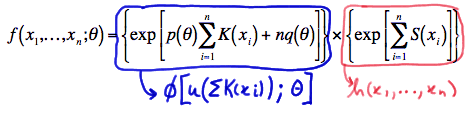
Therefore, the Factorization Theorem tells united states of america that \(Y=\sum_{i=1}^{northward}K(X_i)\) is a sufficient statistic for \(\theta\).
Allow's try the Exponential Criterion out on an case.
Example 24-5
Allow \(X_1, X_2, \ldots, X_n\) exist a random sample from a geometric distribution with parameter \(p\). Detect a sufficient statistic for the parameter \(p\).
Answer
The probability mass role of a geometric random variable is:
\(f(x;p) = (1-p)^{ten-1}p\)
for \(x=1, ii, three, \ldots\) The p.m.f. can be written in exponential grade as:
\(f(10;p) = \text{exp}\left[ x\text{log}(1-p)+\text{log}(one)+\text{log}\left( \frac{p}{1-p} \right)\right] \)
Therefore, \(Y=\sum_{i=1}^{n}X_i\) is sufficient for \(p\). Easy as pie!
By the way, you might want to annotation that well-nigh every p.k.f. or p.d.f. we encounter in this course can be written in exponential form. With that noted, you might want to make the Exponential Criterion the start tool you grab out of your toolbox when trying to find a sufficient statistic for a parameter.

Write Pqqqqrr In Exponential Form,
Source: https://online.stat.psu.edu/stat415/book/export/html/883
Posted by: crispincupong.blogspot.com
0 Response to "Write Pqqqqrr In Exponential Form"
Post a Comment